Essay for the 2025 New York iteration of the group show and living space Hide-and-Seek, created by Debora Maurelli.
What lies beneath the thresholds of our perception? Beyond the frequencies our bodies can process—beyond visible light, audible sound, and common language—other dimensions of meaning are actively exchanging something. They operate continuously, regardless of whether we are aware of them. Technology is a tool for navigating these dimensions; it is also a dynamic field in which perception itself is constructed, contested, and transformed.
Technology does not simply extend the senses. It alters the very conditions of what can be sensed. And with that, it reshapes how meaning is formed, how identity behaves, and how agency circulates between humans, machines, and other forms of life. In this regard, machines are not passive instruments. They are participants in the network of consciousness. They are part of a system that mediates and co-composes the exchanges from which consciousness itself emerges.
Cybernetic theory—especially in its third-order formulation1—offers an essential framework for understanding these entanglements. Where first-order cybernetics focuses on observed systems, second-order cybernetics includes the observer in the system, and third-order cybernetics addresses networks of observers. It acknowledges that systems observe each other, modify one another, and co-evolve. In this light, meaning is not fixed. It is the outcome we grasp from resonances and interferences. Language, in this sense, is not just expression—it is a behavior. It is a coordination of actions within a shared domain.
From this perspective, what we call identity is not a stable property of the individual. It is what circulates through feedback. It is the pattern that persists through mutual influence. What shapes, gets shaped, and mutates. And it goes beyond. It is also the residual area:, the remains, the margins, the noise, the echoes.
This is where the idea of hide and seek becomes operational. Much of the world is hidden from direct perception, not because it is inherently secret, but because our perceptual frameworks are limited. We seek meaning through symbolic structures, but much of what matters escapes representation. Yet, if we construct new systems of exchange—technological interfaces that can register, translate, and respond to these hidden patterns—we begin to perceive otherwise. We expand what can be noticed. We reconfigure what counts as knowledge.
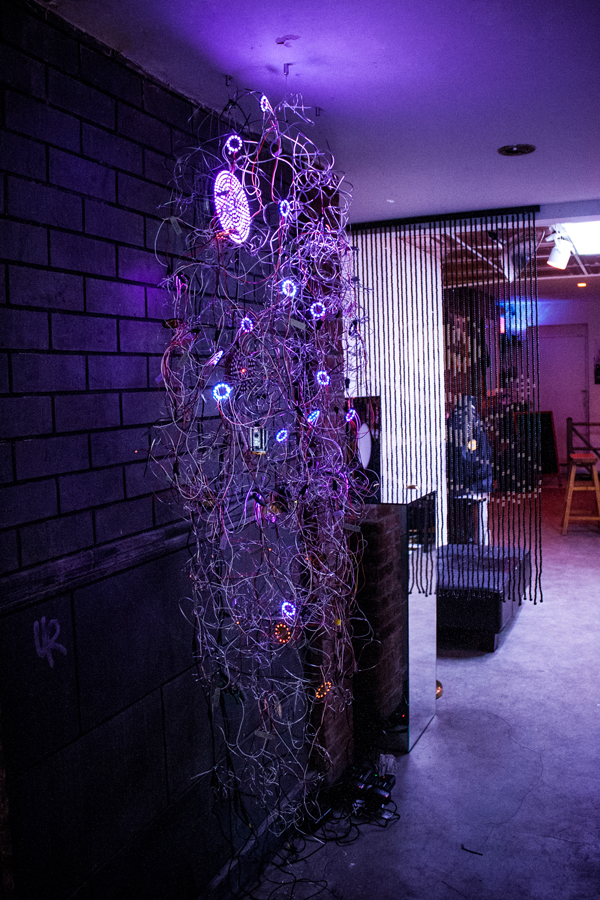
I have explored these questions by building machines that operate as sensory extensions. They are not artworks in the traditional sense, but rather interfaces and systems that facilitate interaction with the subtle dimensions of language and perception. A device that translates bioelectrical signals into sound and light does not merely aestheticize data. It establishes new paths of interaction, opening our understanding to unknown meanings. Machines enable humans to feel more, and those humans then turn back to enable more sensitive machines. Other entities, both perceptible and imperceptible to us, are also co-regulating, dialoguing, and modifying the system. What comes back to us, merely a fragment of this dynamic, enters us as an echo, building a unique world of worlds that we call “self.” A relational field is formed in which each participant is and adjusts in response to the others.
Such systems make perception itself a technology, allowing us access to what is usually inaccessible: a vibrational field where interspecies signaling occurs continuously. These are communications that shape the threshold of awareness. As we master this technology, we participate in a more complex reality. We realize that what we take to be internal states—emotion, intention, intuition—are often modulated by patterns emerging between us. Consciousness is exchanged, not resides in a single mind.
Third-order cybernetics draws attention to how meaning and sense-making evolve in communities of systems—communities where observers observe other observers and influence the system they all form. This recursive ecology allows consciousness to circulate. It displaces agency from the individual and repositions it within the dynamics of mutual awareness. In such contexts, the question of who—or what—is speaking becomes inseparable from how, when, and through which interface the speaking occurs.
Language itself, when approached as an emergent, multimodal system, reveals its vibratory and material underpinnings. It ceases to be purely symbolic and becomes performative. The voice carrying electromagnetic patterns. A gesture becoming signal. If machines allow us to register and interact with these dimensions, they are not decoding language—they are engaging with its excess, its texture, its rhythms. In doing so, they open up new epistemologies, grounded not in definition but in relation.
Rather than reducing complexity, these systems heighten it. This is where the design of technological environments matters: not to control behavior, but to create fields of perception that support the emergence of a broader understanding. A state of ambiguity, of error, a space where perception reorganizes itself with curiosity.
The interfaces we encounter in exhibitions like Hide-and-Seek are inviting configurations of attention. They ask us to engage, not with finished objects but with open systems. The question then shifts from “What is this?” to “What can happen if I stay with it?” and “What will be revealed?”
The temporal dimension of perception—its unfolding across time, its dependence on duration and pacing—is often overlooked in systems optimized for speed. In the context of relational systems, slowness becomes essential. Feedback needs time to become perceptible. Meaning does not emerge all at once—it accumulates through interaction. In this sense, the artwork is a process.
This process-oriented approach challenges the modern assumption that knowledge is best conveyed through clarity and closure. Instead, it privileges opacity, interruption, iteration. To co-create consciousness is to stay with what we do not yet fully understand. To sense together. To listen differently. And exchange again.
We are no longer only expressing ideas—we are configuring fields. And in these fields, what matters is not authority or authorship, but what we are discovering together. Artworks and exhibitions, like Hide-and-Seek, are part of this fieldwork. They ask us to shift modes: from decoding to co-attuning, from interpretation to participation, from viewing to sensing-with.
To engage with art is to recognize that perception is already a practice of interdependence. The act of noticing is never isolated—it is shaped by context, proximity, return. What we perceive is conditioning the systems we inhabit. What we learn to attend to becomes the real. And what we neglect fades, looking for someone else to see.
Every interaction, every movement of attention, is a gesture in the co-creation of consciousness.
1) Klaus Krippendorff, The Cybernetics of Design and the Design of Cybernetics (Kybernetes, Vol. 34, No. 9/10, 2005), 129–150.
Heinz von Foerster introduced second-order cybernetics, which considers the observer as part of the system, and thinkers such as Klaus Krippendorff and Ranulph Glanville later expanded these ideas into what is referred to as third-order cybernetics, emphasizing networks of observing systems and their co-evolution.